
Gilchrist Projected Release Dates
Florida law calls the calculated state-prison date a tentative release date. It reflects the sentence structure and gain-time posted at that point. Gain-time is a statutory credit that can move the projected end of confinement earlier, within legal limits. The date can move again when credits are granted, forfeited, withheld, or restored. It is not a promise that a person will walk out at that exact time.
An actual release date is the date confinement ended in the custodian's record. The destination still matters. A person may return to the community, start supervision, or transfer to another jail, FDOC site, federal authority, or immigration custody. A transfer ends one agency's custody but is not freedom from custody.
| Person's status | Date source | What the date means |
|---|---|---|
| Pretrial at Gilchrist County Jail | Court orders, bond record, warrants, and GCSO custody data | Usually no sentence-based projected date exists |
| Serving a county-jail sentence | Gilchrist judgment, jail credit, and GCSO calculation | Scheduled local custody end, subject to other holds |
| Current FDOC prisoner | FDOC Inmate Population detail | Current Release Date based on data then posted |
| Released or scheduled FDOC prisoner | FDOC Inmate Release Information Search | Release-related record that must be read as past or future |
Find Gilchrist Release Date Records
Begin with the last known custodian. Lancaster Correctional Institution and Lancaster Work Camp are FDOC facilities, not county jail units. Gilchrist County Jail holds local arrestees, pretrial detainees, and qualifying county sentences. Each system calculates and records release through a different route.
- Identify whether the person is at the county jail, in FDOC custody, or only linked to a court case. Do not use location in Gilchrist County as proof of a local sentence.
- For a current state prisoner, open the FDOC Inmate Population Information Search. Search by the six-character DC number when possible, or verify a name match with identifiers.
- Open the correct detail and read the exact Current Release Date label. A date may appear, or the record may carry a designation such as a life sentence.
- For a person already released or scheduled for release, use the FDOC Inmate Release Information Search. Distinguish a future schedule from a completed release.
- For a county-jail sentence, obtain the judgment and jail-credit entry from the Gilchrist Clerk docket, then ask GCSO for its maintained scheduled or actual release calculation.
- For a pretrial booking, check bond and later court orders. Ask whether another warrant or detainer prevents departure even when one case permits release.
The FDOC current-population search leads to the state-prison detail where the date label appears.
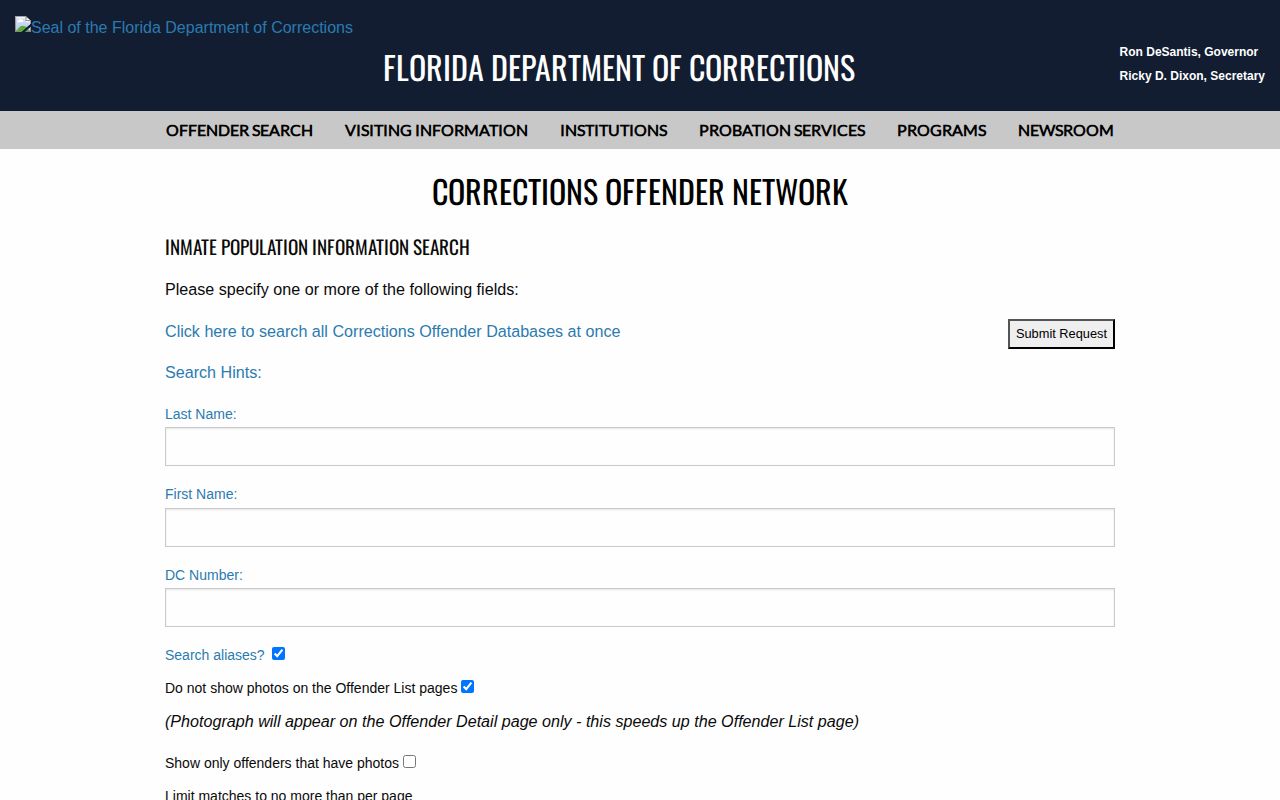
This state search does not cover a county-jail-only sentence, county probation, or a person who has not been sentenced to FDOC.
Note: FDOC says location changes and release dates update nightly, but urgent questions still belong with the responsible corrections office.
Florida Gain-Time Release Rules
Florida Statutes section 944.275 sets the central state-prison framework. Subsection (3)(a) defines the tentative release date as the date projected because of gain-time. It must shift earlier or later as gain-time is awarded, lost, withheld, or restored, but it cannot move later than the maximum sentence expiration date.
For qualifying offenses committed on or after October 1, 1995, subsection (4)(b)3 permits up to ten days per month of incentive gain-time. Subsection (4)(f) prevents those credits from producing release before service of 85 percent of the sentence. Credited county-jail time counts toward that calculation. For a life sentence, the law treats 85 percent as natural life unless clemency or a pardon changes the sentence. Some listed offense categories are not eligible for incentive gain-time.
The older basic gain-time provision applies to older offense-date ranges and should not be used for a modern sentence without checking the law. The Florida Criminal Punishment Code, section 921.002, also limits sentence reduction to authorized incentive or meritorious gain-time and keeps service from dropping below 85 percent. It states that Chapter 947 parole does not apply to Criminal Punishment Code sentences.
These statutes do not support a safe do-it-yourself calculation. The offense date, sentencing system, each judgment, concurrent or consecutive terms, jail credit, mandatory minimums, credit eligibility, disciplinary history, and other custody holds must all be correct. FDOC's posted computation and the sentencing papers control over rough arithmetic.
Why Gilchrist Release Dates Change
A projected date is a moving administrative result. Some changes alter the sentence calculation. Others leave the sentence end intact but change where the person goes. Read the record for the cause instead of assuming every later date is a punishment or every earlier date is parole.
| Factor | Possible effect | Record to check |
|---|---|---|
| Gain-time award or restoration | May move a tentative date earlier within statutory limits | FDOC time computation |
| Gain-time forfeiture or withholding | May move the date later | FDOC disciplinary and calculation records |
| Corrected judgment or jail credit | Can change the sentence base or credit already served | Court order and FDOC posting |
| Concurrent or consecutive term | Changes how multiple sentences combine | All judgments and FDOC sentence structure |
| New warrant, detainer, or hold | May change the destination after the calculated term ends | Holding and receiving agencies |
| Parole or conditional-release action | May set release conditions or alter status for an eligible case | FCOR order and FDOC record |
| Transfer between facilities | Changes location but not release status | FDOC or GCSO custody history |
A detainer is a request or notice that another authority may take custody. It can mean a person finishes one term but does not return to the community. Ask which agency lodged it and whether it remains active. The public FDOC date alone may not answer the physical destination.
Gilchrist Jail Release Date Channel
FDOC does not calculate a county-jail-only sentence. For Gilchrist County Jail, read the local judgment for the sentence and jail credit. Then contact GCSO for the scheduled or actual calculation it maintains. The official GCSO SmartWEB portal can show an exact released date and time after GCSO closes a booking, but its tested released card does not display the formula or release reason.
A pretrial detainee stands in a different position. No sentence has yet produced a tentative date. Bond may authorize release, yet another warrant or hold can keep the person in custody. A dismissal or release order may also precede physical processing. The court event explains the authority. The jail record supplies the actual custody timestamp.
GCSO Public Records can be reached through the official records request channel at records@gcso.us or (352) 440-7361. For one person, identify the booking and date range, then ask for the maintained scheduled and actual release information, release or transfer code, and any code legend needed to read it. The broader Gilchrist County release-record search path explains how to pair that record with the court docket.
Can a SmartWEB release time prove freedom? It proves that GCSO marked its booking released. Ask for the closing code or receiving agency before treating a transfer as a community release.
Gilchrist Court Release Date Check
The Gilchrist Clerk criminal division supplies the legal events behind a county release date. Circuit Court handles felony matters. County Court handles misdemeanors and criminal traffic cases. Search the Gilchrist public court records by case number when known, or use a party search and verify identity carefully. Remote access limits can keep some documents from anonymous web view even when a record is available through the Clerk.
Useful events include bond setting or change, a release order, dismissal, plea, judgment and sentence, jail credit, probation order, warrant recall, violation, revocation, and later satisfaction or discharge. The event date and the physical release time can differ. A judge may sign an order before jail staff complete identity, property, and hold checks. Conversely, a docket entry can post after the person has left. Pair the legal event with GCSO's released timestamp.
For a state-prison sentence, obtain every judgment rather than one docket line. Concurrent sentences run together to the extent the orders provide, while consecutive terms run one after another. A correction to jail credit or sentence structure can reach FDOC after the first public calculation. That is one reason a Current Release Date may change without a new conviction or disciplinary loss.
When a needed document is not remotely visible, contact the Gilchrist Clerk at (352) 463-3170 or clerk@gilchrist.fl.us. Ask for the current copy or certification cost and delivery estimate. The Clerk holds filed court records; GCSO holds its jail calculation; FDOC holds its state-prison time computation. Requesting the right record from the right office avoids a partial answer.
Confirm Gilchrist Actual Release
For a state-prison date, FDOC directs release questions to the Bureau of Admission and Release at (850) 488-9167 or dc.release@fdc.myflorida.com. For county custody, the Gilchrist County Jail information line is (352) 463-3490. Give the correct identifying details and ask whether the stated date is tentative, scheduled, completed, or tied to a transfer.
Preserve the source and access date when the answer matters. Save the DC number or booking number, the exact field label, and the date shown. If the value later moves, those details help the records office identify which calculation or update needs explanation. A screenshot alone does not freeze the official record, but it can make a focused question easier to answer.
Florida VINE can send an alert when a participating source reports release, transfer, or another enabled custody change. It is a notification channel, not the legal release certificate. Register on the matching record and read the event named in the alert. The Gilchrist County VINELink Release Check covers the PIN, delivery choices, and agency-confirmation steps.
A person who leaves confinement may still be under probation, parole, or another form of community supervision. Check the FDOC supervised-population record or the court order rather than treating a prison date as full discharge from every legal obligation.
For an older FDOC release, the downloadable Offender Based Information System data includes a released-inmates cohort and related incarceration-history tables. FDOC says those files update monthly and cover releases from October 1, 1997 forward, subject to the stated scope and removal of sealed or expunged records. That archive can aid an older search, but it is not the channel for a same-day release date.
Note: Actual release, transfer, and discharge are separate events; confirm each one with the agency that records that stage.